These questions have been " borrowed " from FOUR..........THE
WORLD BEST FOOD MAGAZINE and various other sources but the answers are
in my own words, as if I was being asked the questions in an interview.
What’s the most scientific piece of equipment in your kitchen?
The
most useful and versatile piece of equipment is my Henari multi
blender. This is a liquidiser which is great for pureeing soups and
emulsifying salad dressings. It has a total of eight attachment for
everything form the aforementioned, a coffee/ spice grinder, a smoothie
maker and juice extractor which can be used for not only orange and
lemon juice but also for carrot, beetroot and apple juice, amongst many
others. A truly useful piece of equipment.
Could you describe your cooking style for us?
I
describe my style as highly unique as it draws on inspiration and
ingredients from all for corners of the globe and features some very
unusual and unique combinations of flavour that at first glance a really
strange but they actually work.
What’s your favourite meal to make at home?
A
simple pasta dish. Maybe some spaghetti simply tossed with a olive oil,
garlic chilli and Parmesan. And if I have some to hand, some fresh
basil. But my kitchen at home is also my R & D department where i Like to experiment and begin the development of new dishes.
What inspires your cuisine?
Many
things inspire my cuisine. A visit to a specialist food store to search
out new and unusual ingredients to work with and develop new ideas and
dishes. Also reading about other chefs and restaurants on the Internet,
this is a great sauce for discovering ideas for new combinations of
flavour to work and experiment with. The list is actually quite lengthy,
too long to go into great detail here.
Your dishes are regarded as pieces of edible art – did you
envisage becoming considered as such an artist when you embarked on your
career?
For me, food and cooking is both an art form and a
science, (all be it an in-exact science). The science part is in the
actual cooking processes when a variety of technical applications make
transformations the nature and texture of the raw material. The art
comes with the presentation of the food on the plate and thinking about
how and where the individual components are going to be placed.
You are always creating new dishes – what’s your most recent creation?
I suppose one of the most intriguing and interesting has to be the Cauliflower, white chocolate and chervil veloute with
candied baby beetroot (this is candied in a mix of muscavado sugar,
rice vinegar and mirin...the latter being a sweetened Japanese rice wine
that is only ever used as a cooking ingredient or condiment). The whole
thing is garnished with some celery that has been caramelized in fresh
orange juice. Again, this is a highly unusual dish but one that
really works. The combination of of pureed cauliflower and white
chocolate actually tastes quite similar to rice pudding or an a authentic
Italian Blancmange and the addition of the chervil adds a note of
aniseed.
If you could travel anywhere in the world to eat, where would you go and why?
I
think the first stop on the list would have to be DiverXO in Madrid, as
I am totally fascinated and intrigued by this restaurant and the cooking
style and philosophy of its chef and owner, David Munoz. Other
restaurants that I would like to dine at include NOMA (Copenhagen) and
Alinea and Next in Chicago. Again, I have a huge list of places that I
would like to dine at but I need a huge lottery win first.
Do you see yourself as a designer when you cook?
I
suppose that when it comes to deciding how the dish is going to plated,
then, yes, there is some element of design involved in what you are
doing.
Smoking Gun
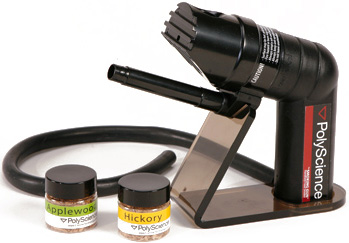
Highly useful kitchen gadget
Wednesday, August 13, 2014

Tuesday, August 12, 2014
Fusion Cuisine.
The following definition of Fusion cuisine is taken from wikiedia and was not written by me...........
Fusion food is a general term for the combination of various forms of cookery and comes in several forms. Regional fusion combines different cuisines of a region or sub-region into a single eating experience. Asian fusion restaurants, which combine the various cuisines of different Asian countries, have become popular in many parts of the United States and United Kingdom. Often featured are East Asian, South-East Asian, and South Asian dishes alongside one another and offering dishes that are inspired combinations of such cuisines. California cuisine is considered a fusion culture, taking inspiration particularly from Italy, France, Mexico, the idea of the European delicatessen, and eastern Asia, and then creating traditional dishes from these cultures with non-traditional ingredients - such as California pizza. Other examples of this style include Tex-Mex, which combines Southwestern United States cuisine and Mexican cuisines, and Pacific rim cuisine, which combines the different cuisines of the various island nations.[2]
In Australia, due to the increasing influx of migrants, fusion cuisine is being reinvented and is becoming increasingly the norm at numerous cafes and restaurants; with Melbourne and Sydney now being considered as some of the best cities in the world with regard to the quality and creativity of Asian-fusion restaurants.[citation needed] Another incarnation of fusion cuisine implements a more eclectic approach, which generally features original dishes that combine varieties of ingredients from various cuisines and regions. Such a restaurant might feature a wide variety of dishes inspired by a combination of various regional cuisines with new ideas.[citation needed]
Foods based on one culture, but prepared using ingredients and flavors inherent to another culture, are also considered forms of fusion cuisine. For instance, pizza made with cheddar and pepper jack cheese, salsa, refried beans or other common taco ingredients is often marketed as "Taco Pizza".[3] This particular dish is a fusion of Italian and Mexican cuisines. Similar approaches have been used for fusion-sushi, such as rolling maki with different types of rice and ingredients such as curry and basmati rice, cheese and salsa with Spanish rice, or spiced ground lamb and capers rolled with Greek-style rice and grape leaves, which resembles inside-out dolmades.
The following section is written in my own words!
But the question has to be asked, is Fusion cuisine really as new as we think it is? To answer this requires some delving back into the annals of time and history. Many items of food that we very much take for granted here in the UK are probably not really as British as we think they are. Take for example thing such as carrots, cabbage and rosemary. These are all seen as being quintessentially British but the reality of the matter is that these common food items were actually introduced to Britain by the Romans. So, as a result of this, much of what is considered to be traditional or classical British cuisine could actually be seen as being a form of Fusion cooking.
Another common feature of British cooking is the potato. There actually was a time when we did not eat potatoes here in the UK due to the fact that they are not native to our shores. The potato ( often seen as being a humble ingredient) actually originates from South America and was not known in this country until Elizabethan times when it was brought here by none other than Sir Walter Raleigh.
Much of what we consider to be Italian food is also a form of fusion cooking. When you seriously think about it, how many Italian dishes feature the tomato in one form or another? There must be thousands but these should all really be considered as Fusion dishes due to the fact that, until Columbus made his first voyage to the New world, there were no tomatoes growing in or native to Europe.
There are so many things that we use in our daily food consumption that are not truly British, Take for instance Tomato ketchup, something which is seen as been typically British. However, if you give some serious consideration to the ingredients that go into your ketchup, where do they actually originate from? Take for instance the key flavouring, tomatoes, which as I have already pointed out originate from South America. Then there are the various spices which originate from India and other points in Asia. The same can be said of Brown sauce, (HP and Daddies, for example). Both of these contain tamarind and other spices that are not native to the UK but actually originate from Asia and India. And Worcestershire sauce is another food item that is synonymous with Britain and yet all of the ingredients used in this great sauce are of Indian or Asian originate.
Another area of interest is Indian cuisine, although the stuff you get in most so called Indian restaurants here in the UK would be unrecognisable to anyone on the sub continent. The word curry in India actually means gravy (or sauce) and is very rarely used in the culinary vocabulary of that vast country. The whole idea of curry as we know it in Britain dates back to the days of the British Raj and the returning expatriates bringing back various spice blends so that they could continue to eat the spicy foods to which thay had become accustomed during their posting on the sub continent.
The list of food items that we all too often take for granted is vast but a few other prime examples that are not of British origin but are staples in our daily diet are Avocados, chocolate, chillies, sweet corn and turkey. All of these originate from the New World and yet it is very hard to imagine life without them.
So next time you hear any form of criticism of the whole idea and concept of Fusion cuisine, then give some serious thought to the points that I have made here. And as for the concept of a truly unique and British cuisine, does such a thing really exist?
Fusion food is a general term for the combination of various forms of cookery and comes in several forms. Regional fusion combines different cuisines of a region or sub-region into a single eating experience. Asian fusion restaurants, which combine the various cuisines of different Asian countries, have become popular in many parts of the United States and United Kingdom. Often featured are East Asian, South-East Asian, and South Asian dishes alongside one another and offering dishes that are inspired combinations of such cuisines. California cuisine is considered a fusion culture, taking inspiration particularly from Italy, France, Mexico, the idea of the European delicatessen, and eastern Asia, and then creating traditional dishes from these cultures with non-traditional ingredients - such as California pizza. Other examples of this style include Tex-Mex, which combines Southwestern United States cuisine and Mexican cuisines, and Pacific rim cuisine, which combines the different cuisines of the various island nations.[2]
In Australia, due to the increasing influx of migrants, fusion cuisine is being reinvented and is becoming increasingly the norm at numerous cafes and restaurants; with Melbourne and Sydney now being considered as some of the best cities in the world with regard to the quality and creativity of Asian-fusion restaurants.[citation needed] Another incarnation of fusion cuisine implements a more eclectic approach, which generally features original dishes that combine varieties of ingredients from various cuisines and regions. Such a restaurant might feature a wide variety of dishes inspired by a combination of various regional cuisines with new ideas.[citation needed]
Foods based on one culture, but prepared using ingredients and flavors inherent to another culture, are also considered forms of fusion cuisine. For instance, pizza made with cheddar and pepper jack cheese, salsa, refried beans or other common taco ingredients is often marketed as "Taco Pizza".[3] This particular dish is a fusion of Italian and Mexican cuisines. Similar approaches have been used for fusion-sushi, such as rolling maki with different types of rice and ingredients such as curry and basmati rice, cheese and salsa with Spanish rice, or spiced ground lamb and capers rolled with Greek-style rice and grape leaves, which resembles inside-out dolmades.
The following section is written in my own words!
But the question has to be asked, is Fusion cuisine really as new as we think it is? To answer this requires some delving back into the annals of time and history. Many items of food that we very much take for granted here in the UK are probably not really as British as we think they are. Take for example thing such as carrots, cabbage and rosemary. These are all seen as being quintessentially British but the reality of the matter is that these common food items were actually introduced to Britain by the Romans. So, as a result of this, much of what is considered to be traditional or classical British cuisine could actually be seen as being a form of Fusion cooking.
Another common feature of British cooking is the potato. There actually was a time when we did not eat potatoes here in the UK due to the fact that they are not native to our shores. The potato ( often seen as being a humble ingredient) actually originates from South America and was not known in this country until Elizabethan times when it was brought here by none other than Sir Walter Raleigh.
Much of what we consider to be Italian food is also a form of fusion cooking. When you seriously think about it, how many Italian dishes feature the tomato in one form or another? There must be thousands but these should all really be considered as Fusion dishes due to the fact that, until Columbus made his first voyage to the New world, there were no tomatoes growing in or native to Europe.
There are so many things that we use in our daily food consumption that are not truly British, Take for instance Tomato ketchup, something which is seen as been typically British. However, if you give some serious consideration to the ingredients that go into your ketchup, where do they actually originate from? Take for instance the key flavouring, tomatoes, which as I have already pointed out originate from South America. Then there are the various spices which originate from India and other points in Asia. The same can be said of Brown sauce, (HP and Daddies, for example). Both of these contain tamarind and other spices that are not native to the UK but actually originate from Asia and India. And Worcestershire sauce is another food item that is synonymous with Britain and yet all of the ingredients used in this great sauce are of Indian or Asian originate.
Another area of interest is Indian cuisine, although the stuff you get in most so called Indian restaurants here in the UK would be unrecognisable to anyone on the sub continent. The word curry in India actually means gravy (or sauce) and is very rarely used in the culinary vocabulary of that vast country. The whole idea of curry as we know it in Britain dates back to the days of the British Raj and the returning expatriates bringing back various spice blends so that they could continue to eat the spicy foods to which thay had become accustomed during their posting on the sub continent.
The list of food items that we all too often take for granted is vast but a few other prime examples that are not of British origin but are staples in our daily diet are Avocados, chocolate, chillies, sweet corn and turkey. All of these originate from the New World and yet it is very hard to imagine life without them.
So next time you hear any form of criticism of the whole idea and concept of Fusion cuisine, then give some serious thought to the points that I have made here. And as for the concept of a truly unique and British cuisine, does such a thing really exist?
Saturday, August 9, 2014
Salt.An exploration.
Another subject which has been in the news again this week is none other
than Salt and the fact that we are consuming far more of the stuff than
we should in our diets. Yes, this is very true for those who consume
vast quantities of pre - packaged food or the so called convenient ready
meals. These things do contain higher levels of salt than is really
necessary (or good for you). However, the reality is that it is not the
actual salt that is bad for you but the Sodium Ferrocyanide or the
Magnesium Hydroxide Carbonate that is added as an anti - caking agent
that is bad for you. So, when buying salt, always check the label to see
what it contains. In truth, the only thing that should be in your salt
is SALT. To guarantee that you are buying 100% pure salt, with no
additives. I recommend buying Maldon Sea Salt or a similar variety,
depending on what is available in your region.
The many various types of salt and the following are just a few examples.
Pink Himalayan Salt
 There are many
types of salt out there, designed for all sorts of uses. Here are a few
popular ones that you might want to explore.
There are many
types of salt out there, designed for all sorts of uses. Here are a few
popular ones that you might want to explore.
 Hawaiian Black Salt.
 This is so true!

And you may be interested to now that the word Salary originates from the word salt. This is s a result of he Roman legionnaires were paid in salt as, in those days it was considered to be a highly prized and valuable commodity.
The many various types of salt and the following are just a few examples.
Pink Himalayan Salt
And you may be interested to now that the word Salary originates from the word salt. This is s a result of he Roman legionnaires were paid in salt as, in those days it was considered to be a highly prized and valuable commodity.
New stuff from my world of ingredient and flavour transformation.
#paulsplayground.........Dinner tonight is going to be a spice Turkey meatloaf, red eye gravy and scallion mashed potatoes.
 Sometimes you need some awesome comfort food
to feel satisfied. And this certainly was satisfying. Spiced Turkey
meatloaf, red eye gravy and scallion mashed potato (loaded with lashings
of real butter.......of course)!
Sometimes you need some awesome comfort food
to feel satisfied. And this certainly was satisfying. Spiced Turkey
meatloaf, red eye gravy and scallion mashed potato (loaded with lashings
of real butter.......of course)!
 Paid a visit to the farmers market this
morning and picked up some fantastic heritage tomatoes and a great bunch
of radishes. The problem with the so called tomatoes that they sell in
the supermarkets is that they are what are known as F1 hybrids. This
means that they have been scientificly modified to grow to a uniform
size and to all ripen at the same time.
Paid a visit to the farmers market this
morning and picked up some fantastic heritage tomatoes and a great bunch
of radishes. The problem with the so called tomatoes that they sell in
the supermarkets is that they are what are known as F1 hybrids. This
means that they have been scientificly modified to grow to a uniform
size and to all ripen at the same time.


Guy Fieri and the TripleD team need to get 'round my gaff and check out these bad boys. Minced steak burger with mushroom/ seaweed seasoning + fish sauce. Served on a brioche bun with jalapeno/ toasted ajwain seed butter, little gem lettuce, red onion/ apricot/ mirin jam and mature cheddar cheese. #paulsplayground.

Guy Fieri and the TripleD team need to get 'round my gaff and check out these bad boys. Minced steak burger with mushroom/ seaweed seasoning + fish sauce. Served on a brioche bun with jalapeno/ toasted ajwain seed butter, little gem lettuce, red onion/ apricot/ mirin jam and mature cheddar cheese. #paulsplayground.
Thursday, August 7, 2014


Whole wheat egg noodles, soy cured salmon, chipotle chilli, hoi sin, lemon curd, kimchi, soft boiled egg. #paulsplayground #iloveasianflavours
 Pasta for lunch! Penne with ricotta, chestnut mushrooms, smoked bacon, Parmesan and raw egg yolk. #paulsplayground
 Revisiting a creation from a few weeks ago.
Slow cooked chicken with curry, sour cherry, yogurt and a warm salsa of
fave beans, tomato, pine apple and peas. #paulsplayground
Revisiting a creation from a few weeks ago.
Slow cooked chicken with curry, sour cherry, yogurt and a warm salsa of
fave beans, tomato, pine apple and peas. #paulsplayground


Anti
pasto platter with Serrano ham, Chorizo, cauliflower/ black pepper/
white chocolate panna cotta, Parmesan, heritage tomatoes, olive oil,
poached egg and maybe some other stuff that I've overlooked. #paulsplayground —  drinking beer.
drinking beer.
Subscribe to:
Posts (Atom)